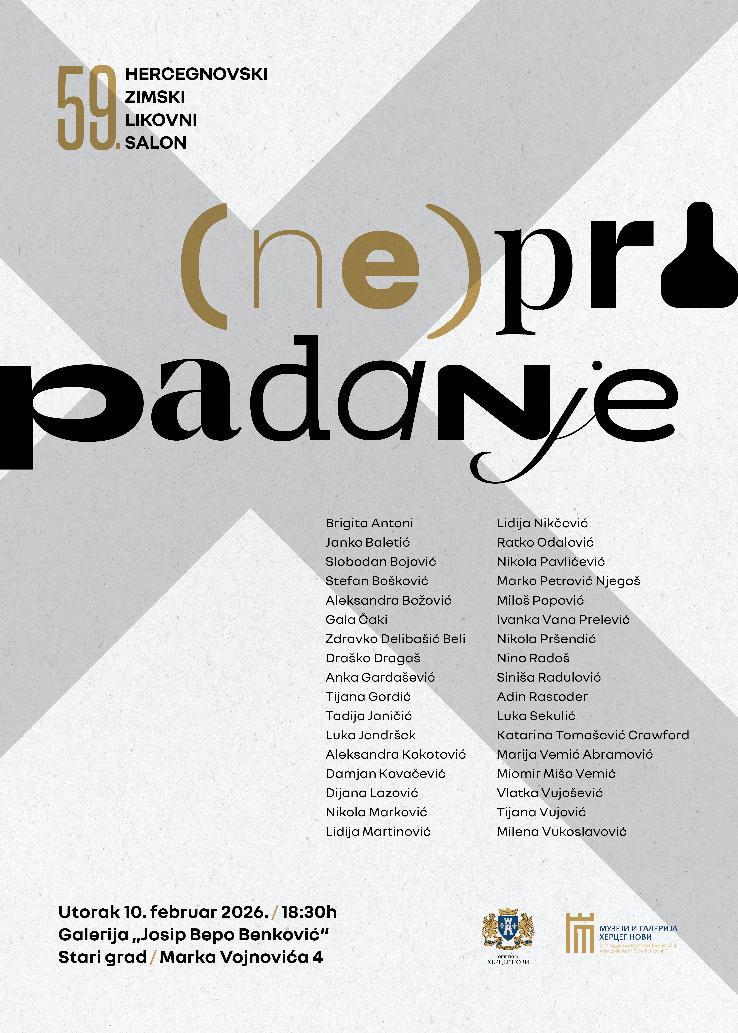
THE 59TH WINTER ART SALON
Josip Bepo Benkovic Gallery
February 10, 2026 – March 10, 2026
THE 59TH WINTER ART SALON
Josip Bepo Benkovic Gallery
February 10, 2026 – March 10, 2026
I am profoundly honored to participate in The 59th Winter Art Salon in Herceg Novi , one of the oldest and most venerable art exhibitions in this region. To be part of a tradition that has endured for nearly six decades is to enter into a conversation that extends far beyond the present moment—it is to become part of a continuum of artistic inquiry that connects past, present, and future.
There is something deeply philosophical about the nature of international exhibitions. They exist as temporal meeting points where different worldviews, cultural memories, and aesthetic philosophies converge. In a world often fragmented by borders—both physical and ideological—art offers us a universal language through which we can explore our shared humanity. These exhibitions are not merely displays of objects; they are spaces of encounter, where meaning is created not just by individual works, but by the dialogue between them, and between the artists and viewers who inhabit these spaces.
The importance of international exchange in art cannot be overstated. It challenges us to move beyond the familiar, to confront the otherness that ultimately reveals our interconnectedness. When artists from different traditions and geographies come together, we create a polyphony of voices—each distinct, yet harmonizing in ways that illuminate truths no single perspective could capture alone. We are reminded that art is not created in isolation, but emerges from the vast network of human experience, thought, and feeling.
I am profoundly honored to participate in The 59th Winter Art Salon in Herceg Novi , one of the oldest and most venerable art exhibitions in this region. To be part of a tradition that has endured for nearly six decades is to enter into a conversation that extends far beyond the present moment—it is to become part of a continuum of artistic inquiry that connects past, present, and future.
There is something deeply philosophical about the nature of international exhibitions. They exist as temporal meeting points where different worldviews, cultural memories, and aesthetic philosophies converge. In a world often fragmented by borders—both physical and ideological—art offers us a universal language through which we can explore our shared humanity. These exhibitions are not merely displays of objects; they are spaces of encounter, where meaning is created not just by individual works, but by the dialogue between them, and between the artists and viewers who inhabit these spaces.
The importance of international exchange in art cannot be overstated. It challenges us to move beyond the familiar, to confront the otherness that ultimately reveals our interconnectedness. When artists from different traditions and geographies come together, we create a polyphony of voices—each distinct, yet harmonizing in ways that illuminate truths no single perspective could capture alone. We are reminded that art is not created in isolation, but emerges from the vast network of human experience, thought, and feeling.